How Much Does a Forklift Weigh? Complete Guide by Capacity and Configuration
Service weight (or operating weight) refers to the weight of the forklift itself, including the chassis, counterweight, power system, mast, fuel or battery, forks, and standard equipment, but excluding the load being carried.
In general, a typical 2-ton to 3-ton counterbalance forklift weighs around 3.3 ton to 4.4 ton, heavy-duty diesel forklifts can weigh more than 10 tons.
This guide explains the typical weight of forklifts by capacity and shows how different configurations can increase the overall weight.
1. Typical Forklift Weight by Capacity
Because forklift weight can vary significantly depending on configuration, the following table provides the approximate weight of standard-configuration forklifts.
For comparison purposes, the standard configuration in this table means: standard 2-stage mast, standard 3 m lifting height, pneumatic tires, no attachments(such as side shifters or clamps), no cab, standard fork length.
| Rated Capacity | Internal Combustion Forklift | Lead-Acid Electric Forklift | Lithium-Ion Electric Forklift |
| 1.5 tons | 2.5–2.7 tons | 2.9–3.1 tons | 2.6–2.8 tons |
| 2.0 tons | 3.3–3.5 tons | 3.8–4.0 tons | 3.5–3.7 tons |
| 2.5 tons | 3.6–3.8 tons | 4.0–4.2 tons | 3.7–3.9 tons |
| 3.0 tons | 4.2–4.4 tons | 4.5–4.9 tons | 4.2–4.4 tons |
| 3.5 tons | 4.4–4.8 tons | 5.0–5.2 tons | 4.6–4.8 tons |
| 5.0-ton Mini | 6.5–6.7 tons | — | — |
| 5.0 tons | 8.0–8.2 tons | — | — |
| 7.0 tons | 9.2–9.4 tons | — | — |
| 10 tons | 12.5–13.0 tons | — | — |
These figures are intended as practical reference values for standard configurations, rather than fixed specifications for every forklift model.
Why Is a Lead-Acid Electric Forklift Heavier?
As shown in the table, a lead-acid electric forklift is generally heavier than an internal combustion forklift of the same rated capacity, often by around 500 kg.
The main reason is the battery. A large lead-acid battery is very heavy and also plays an important role in counterbalancing the load.
By comparison, a lithium-ion battery is much lighter—typically around one-third the weight of a comparable lead-acid battery for the same energy capacity. Because of this, lithium-ion forklifts need additional structural or counterweight design to maintain the required balance and stability.
As a result, a lithium-ion electric forklift of the same rated capacity can have a total weight relatively close to that of an internal combustion forklift.
2. What Factors Affect Forklift Weight?
The standard weight listed above is only the starting point. Several common configurations can add hundreds of kilograms to the forklift's total weight.
2.1 Lifting Height and Mast Configuration
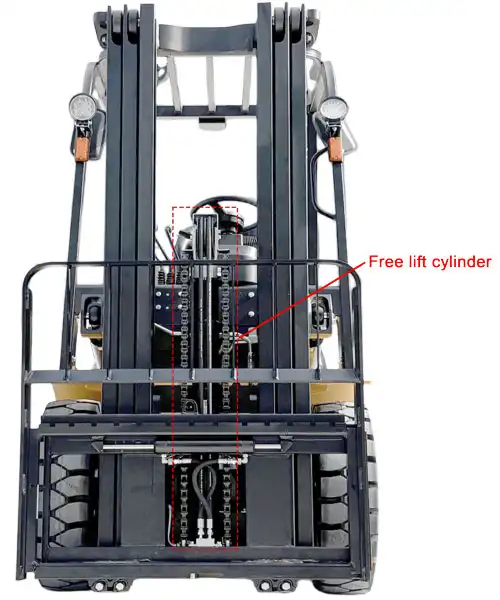
The standard 3 m 2-stage mast can be considered the baseline configuration.
As the lifting height increases, the mast requires more steel and stronger structural components, so the forklift becomes heavier.
A full-free mast also adds weight because it uses an additional center free lift cylinder and related components.
The following figures provide a practical estimate of the additional weight:
| Rated Capacity | Weight Increase for Every Additional 1 m of Lift Height | Free lift cylinderWeight |
| 1.5 tons | 80 kg | 60 kg |
| 2.0 tons | 100 kg | 80 kg |
| 2.5 tons | 120 kg | 80 kg |
| 3.0 tons | 150 kg | 100 kg |
| 3.5 tons | 180 kg | 120 kg |
| 5.0-ton Mini | 200 kg | 150 kg |
| 5.0 tons | 250 kg | 200 kg |
| 7.0 tons | 350 kg | 250 kg |
| 10 tons | 450 kg | 300 kg |
For example, increasing a 3-ton forklift's lifting height from standard 3.0 m to full free-4.5 m means an additional 1.5 m of lift height. Based on the above estimate, the additional weight from the increased mast height would be approximately: 0.15 × 1.5+0.1 = 0.325 tons.
2.2 Tire Type
Standard forklifts are commonly equipped with pneumatic tires.
If all four tires are replaced with solid tires, the forklift can become approximately 0.1–0.5 ton heavier, depending on the forklift capacity and tire size.
| Forklift | Additional Weight with Solid Tires (Approx.) |
| 1.5 tons | 62 kg |
| 2.0 tons | 82 kg |
| 2.5 tons | 82 kg |
| 3.0 tons | 112 kg |
| 3.5 tons | 112 kg |
| 4.0 tons | 190 kg |
| 4.5 tons | 190 kg |
| 5.0-ton Mini | 190 kg |
| 5.0 tons | 348 kg |
| 7.0 tons | 348 kg |
| 10 tons | 588 kg |
The difference becomes more significant on heavy-duty forklifts because they use much larger tires.
2.3 Attachments
Forklift attachments can add a substantial amount of weight.
Common attachments include: side shifter, side shifter + fork positioner, paper roll clamp, bale clamp.
Approximate additional weights are shown below:
| Rated Capacity | Side Shifter | Side Shifter + Fork Positioner | Paper Roll Clamp | Bale Clamp |
| 1.5 tons | 55 kg | 70 kg | 400 kg | 500 kg |
| 2.0 tons | 58 kg | 78 kg | 700 kg | 600 kg |
| 2.5 tons | 58 kg | 78 kg | 700 kg | 600 kg |
| 3.0 tons | 74 kg | 90 kg | 800 kg | 600 kg |
| 3.5 tons | 74 kg | 90 kg | 800 kg | 600 kg |
| 5.0-ton Mini | 180 kg | 260 kg | 1,000 kg | 700 kg |
| 5.0 tons | 330 kg | 550 kg | 1,200 kg | 700 kg |
| 7.0 tons | 330 kg | 550 kg | 1,200 kg | 700 kg |
| 10 tons | — | 700 kg | 1,400 kg | 700 kg |
2.4 Cab and Air Conditioning
A full enclosed cab can also increase the overall weight of a forklift. Adding air conditioning adds further weight.
| Forklift Capacity | Full Enclosed Standard Cab | Full Enclosed Cab + Air Conditioning |
| 1.5 tons | 150 kg | 200 kg |
| 2.0–2.5 tons | 200 kg | 250 kg |
| 3.0–3.5 tons | 250 kg | 300 kg |
| 5.0 tons | 300 kg | 350 kg |
| 7.0 tons | 400 kg | 450 kg |
| 10 tons | 450 kg | 550 kg |
This is particularly important for customers operating forklifts outdoors in very hot or cold climates, where air conditioning or heating is commonly required.
2.5 Fork Length
The longer the forks, the heavier they become. Standard fork lengths typically vary according to forklift capacity:
| Forklift Capacity | Standard Fork Length | Additional Weight per 100 mm Increase for the Pair of Forks |
| 1.5 tons | 920 mm | 6 kg |
| 2.0–2.5 tons | 1,070 mm | 7 kg |
| 3.0–3.5 tons | 1,070 mm | 9 kg |
| 4.5–5.0 tons | 1,220 mm | 12 kg |
| 6.0–7.0 tons | 1,220 mm | 18 kg |
| 8.0–10 tons | 1,220 mm | 25 kg |
For example, changing the forks on a 3-ton forklift from 1,070 mm to 2,000 mm increases the length by 930 mm. The additional fork weight would therefore be approximately:
9 kg × 9.3 ≈ 84 kg
2.6 Battery Weight
For electric forklifts, battery weight is another major factor.
As a general reference:
·Lead-acid battery: approximately 30 kg per additional kWh
·Lithium-ion battery: approximately 12 kg per additional kWh
This is why battery capacity should not be considered only in terms of operating time. A larger battery also affects the forklift's overall weight and balance.
3. How to Estimate Forklift Weight
Let's take a practical example.
Suppose we have a 3-ton diesel forklift with the following configuration:
·4.5 m full-free mast
·Solid tires
·Side shifter + fork positioner
·Full cab with air conditioning
·2,000 mm forks
The standard 3-ton forklift weighs approximately 4.3 tons.
We can then estimate the additional weight from the options:
1. 4.5 m full-free mast:0.15 × 15 + 0.10 = 0.325 ton
2. Side shifter + fork positioner: 0.112 ton
3. Full cab + air conditioning: 0.30 ton
4. 2,000 mm forks: 0.009 × 9.3 ≈ 0.084 ton
Estimated Total Weight:
4.3 + 0.325 + 0.112 + 0.30 + 0.09 = 5.121 tons
So, the estimated forklift weight would be approximately 5.12 tons.
However, this kind of calculation should be regarded as an estimate only. For a quotation, transportation plan, or official shipping documentation, the manufacturer's actual specification should always take priority.
4. How to Find a Forklift's Exact Weight
4.1 Check the Nameplate
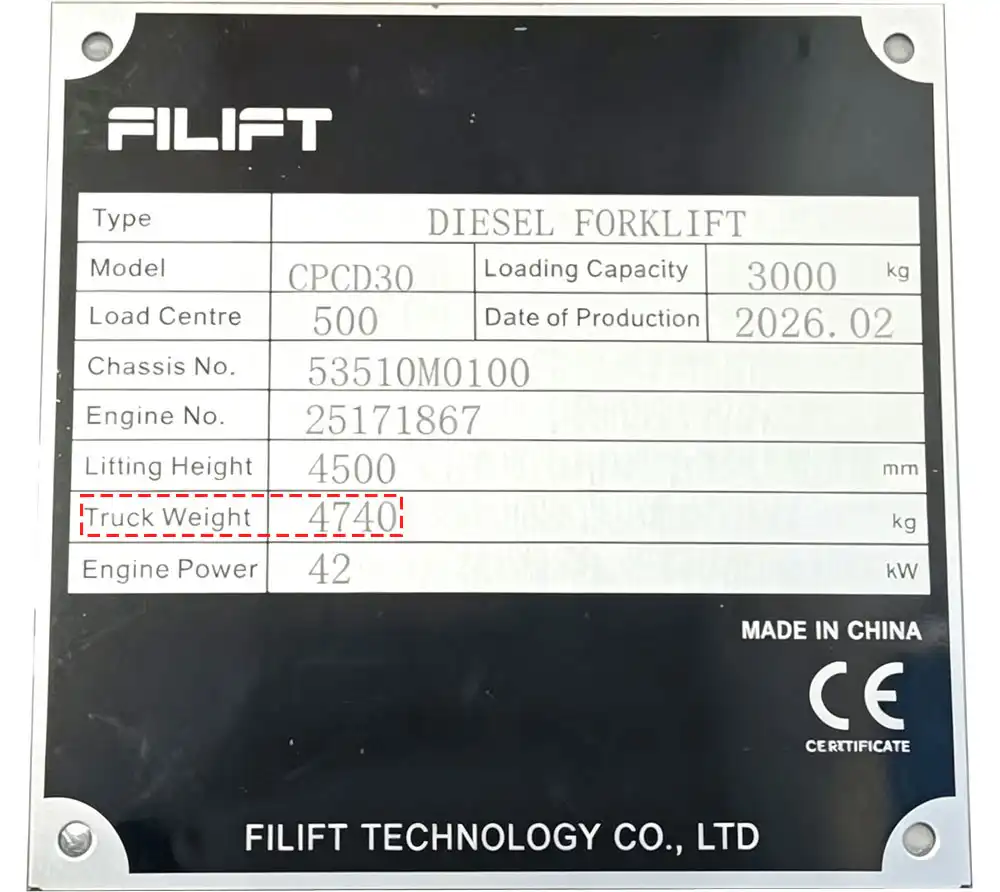
The manufacturer's nameplate, usually located near the operator's compartment or on the forklift frame, provides official specifications.
Look for terms such as:
·Service Weight
·Operating Weight
·Truck Weight
·Unladen Weight
The exact terminology varies by manufacturer and market.
4.2 Check the Manufacturer's Manual or Specification Sheet
The manufacturer's product brochure, technical specification sheet, or operating manual normally lists the forklift's weight under a specific configuration.
However, remember that the listed weight may apply to a standard configuration only.
If the forklift has a different mast, battery, tire, attachment, cab, or fork length, the actual weight may be different.
4.3 Weigh the Forklift
If the forklift has been modified, fitted with additional attachments, or equipped with a different battery, the most reliable method is to weigh the complete machine on a truck scale or industrial weighbridge.
5. Why Is Forklift Weight Important?
5.1 Floor Load Capacity
Before operating a heavy forklift on a second floor, mezzanine, steel platform, or other elevated structure, make sure the floor has sufficient load-bearing capacity.
The structure must be capable of supporting the combined load of the forklift and the cargo, with an appropriate safety margin.
A heavy forklift operating on an unsuitable floor can cause serious structural damage or even collapse.
This is particularly important for high-capacity forklifts, which can weigh several tons even before any cargo is lifted.
5.2 Transportation and Handling Costs
Forklift weight directly affects transportation requirements and logistics costs.
When shipping a forklift, its weight must be considered together with its dimensions to determine:
·The appropriate trailer or transport vehicle
·Whether the machine can be transported normally or requires special transport
·Container loading arrangements
·Lifting and loading methods
·Shipping costs and handling charges
For international shipments, accurate weight information is also important when preparing shipping and customs documents.
6. Forklift Weight vs. Rated Capacity: Don't Confuse the Two
Many people confuse a forklift's own weight with its rated lifting capacity. For example, when we refer to a 3-ton forklift, the "3 tons" means its rated lifting capacity, not its own weight. A forklift's service weight is usually around 1.5 to 2 times its rated capacity. The reason is simple: a counterbalance forklift relies on its rear counterweight and overall machine mass to maintain the balance of the forklift-load system. The forklift needs sufficient weight at the rear to prevent it from tipping forward when lifting a heavy load.
A 3-ton forklift does not weigh 3 tons. Its own service weight may be around 4.2–4.4 tons in a standard configuration.
The difference exists because a counterbalance forklift needs substantial machine weight, especially at the rear, to balance the load carried on the forks.
Rated capacity = How much the forklift is designed to lift
Service weight = How much the forklift itself weighs
These are two completely different specifications.
Conclusion
So, how much does a forklift weigh?
As a general reference, a standard 2-ton to 3-ton counterbalance forklift weighs approximately 3.3–4.4 tons, while larger heavy-duty forklifts can weigh more than 10 tons.
More importantly, the rated capacity and the forklift's own weight should never be confused. A "3-ton forklift" refers to its 3,000 kg rated lifting capacity, not a 3,000 kg machine weight.
Mast height, tire type, attachments, cab, fork length, and battery can all significantly change the final weight. For transportation, floor loading, and other applications where an accurate figure is important, the manufacturer's official specification or an actual weighbridge measurement should always be used.
Understanding forklift weight helps buyers choose the right equipment, plan safe operations, and calculate transportation and handling requirements more accurately.
FAQ
How much does a 2-ton forklift weigh?
A standard 2-ton internal combustion forklift typically weighs around 3.3–3.5 tons. A lead-acid electric version may weigh around 3.8–4.0 tons, while a lithium-ion electric version may weigh around 3.5–3.7 tons.
How much does a 3-ton forklift weigh?
A standard 3-ton internal combustion forklift typically weighs approximately 4.2–4.4 tons. The actual weight will increase with higher mast heights, solid tires, attachments, a cab, longer forks, and other options.
How much does a 5-ton forklift weigh?
A standard 5-ton forklift can weigh approximately 8.0–8.2 tons, while a 5-ton mini forklift may weigh around 6.5–6.7 tons.
How much does a 10-ton forklift weigh?
A standard 10-ton diesel forklift typically weighs around 12.5–13 tons, depending on the specific configuration.
Why is an electric forklift sometimes heavier than a diesel forklift?
A lead-acid electric forklift can be heavier because its large battery is extremely heavy and also contributes to the machine's counterbalance.
Does a larger mast make a forklift heavier?
Yes. A higher mast generally requires more structural steel and stronger components, which increases the forklift's overall weight.
Do solid tires make a forklift heavier?
Yes. Solid tires are generally heavier than pneumatic tires. Depending on the forklift size, switching from pneumatic to solid tires can add approximately 100–500 kg or more.
Does a forklift attachment affect the lifting capacity?
Yes. An attachment adds its own weight and can also move the effective load center farther away from the forklift. Therefore, the forklift's actual capacity may be lower when using certain attachments.